
Every hotel has felt it: a slow week that suddenly fills up, or a holiday weekend that books out faster than expected.
Demand rarely moves in a straight line, and for small and mid-sized properties, catching those shifts early is often the difference between a fully booked calendar and a room sitting empty at a discount.
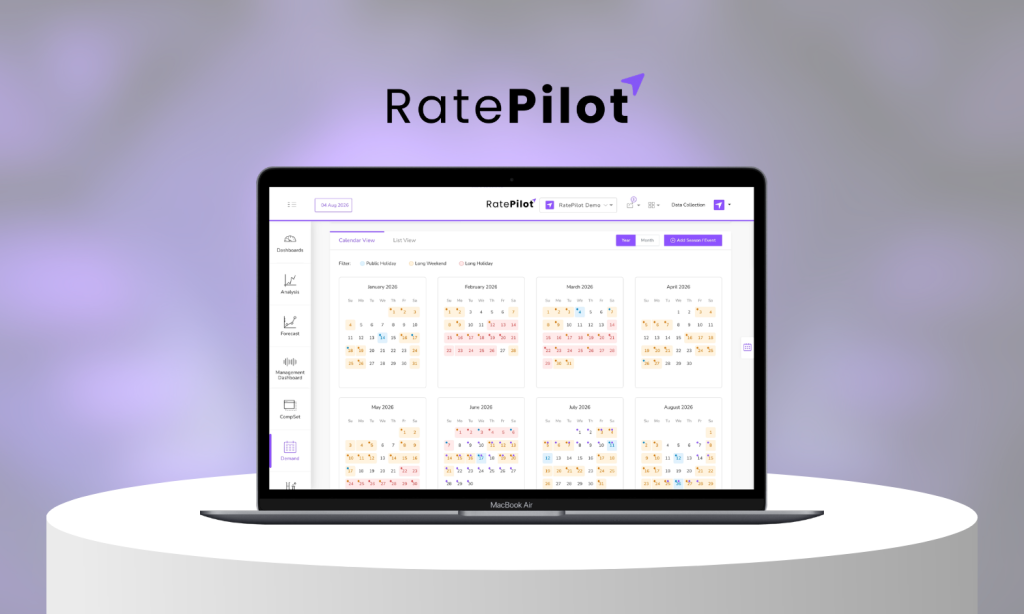
This is exactly the gap RatePilot’s hotel demand calendar, part of its Demand Monitoring feature, was built to close.
Seeing Demand Before It Hits Your Booking Curve
Holiday & Long Weekend Calender
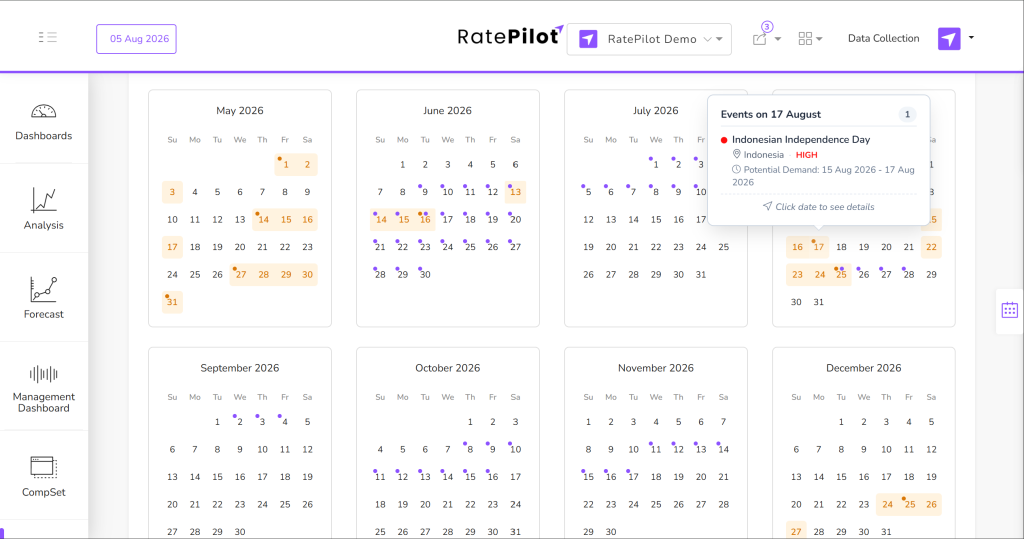
The hotel demand calendar inside RatePilot’s Demand Monitoring gives revenue managers a calendar view built specifically to flag the dates that matter most.
Public holidays and long weekends are already mapped out, so instead of manually cross-checking a separate holiday calendar against occupancy reports, a property can see at a glance which upcoming dates are likely to see a surge in demand and plan pricing around them ahead of time.
Built For Properties With International Guests
Filter by Country & Year
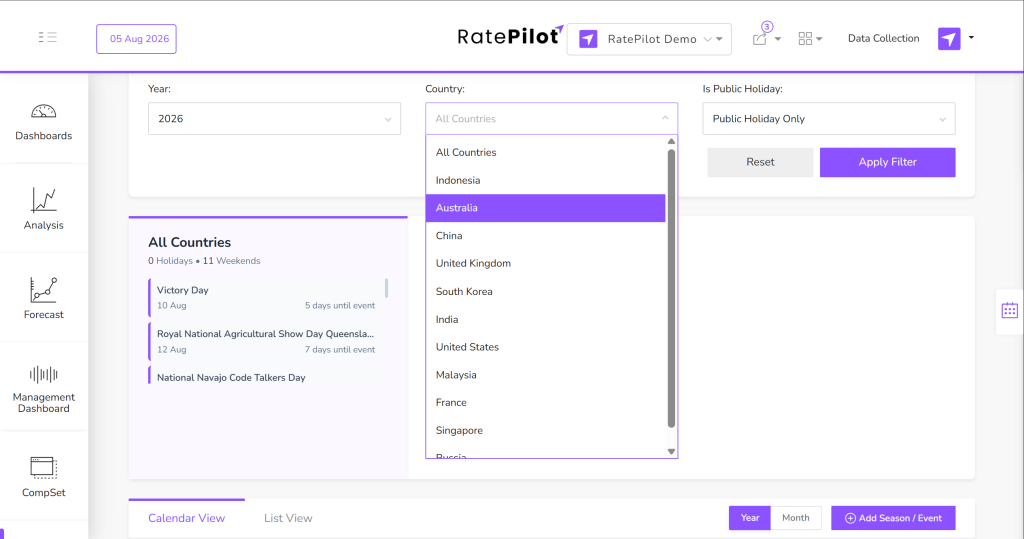
Bali and Southeast Asia’s hospitality market draws travelers from many different countries, and holidays do not fall on the same dates everywhere. The demand calendar lets users filter by country, making it possible to see when Australian, Chinese, or European holidays fall, alongside local Indonesian dates.
Combined with a year filter that covers last year, this year, and next year, a revenue manager can compare how a holiday period performed previously and plan rates for the same period well in advance.
Local Events Matter Just as Much as National Holidays
Add Season & Event Manual
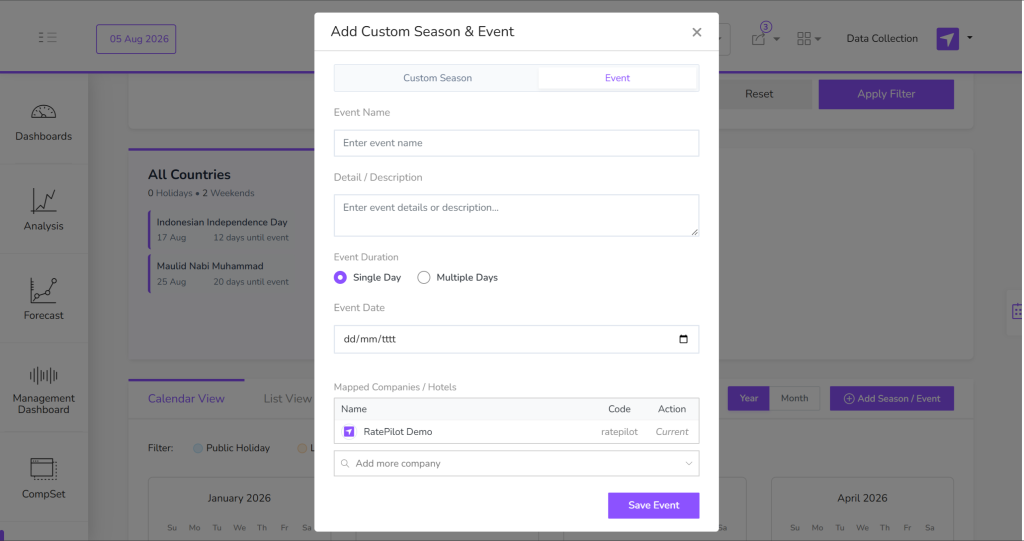
National holidays are only part of the picture. A concert, festival, or ceremony happening near a property can shift local demand just as much as a long weekend, but these events rarely appear on any standard calendar.
RatePilot’s hotel demand calendar addresses this by letting users manually add local events that affect demand around their specific property, keeping the calendar relevant to what is actually happening in that area rather than relying only on generic national data.
From Calendar to Action
On its own, a calendar of dates is only useful if it changes what happens next.
From the insight the demand calendar surfaces, a revenue manager can make an informed Dynamic Pricing decision, whether that means adjusting rates ahead of a flagged long weekend or reacting to a manually added local event before it affects the booking pace.
Paired with the Intelligent Dashboard’s occupancy, ADR, and RevPAR figures, it becomes easier to tell whether a spike in demand is being captured at the right price or left on the table.
Holidays, long weekends, and local events will keep shaping demand with or without a system watching for them. The properties that stay ahead are the ones that can see these patterns coming instead of reacting after the booking pace has already shifted. That is what RatePilot’s hotel demand calendar is built to do.
Ready to see how the hotel demand calendar works for your property? Book a demo with RatePilot.